


StartUps Are Exciting!
- Tom Hackett
- Sep 1, 2025
- 9 min read
Updated: Sep 23, 2025

🎤 TED Talk Style - by Tom Hackett
Our family’s housing story and our response: My wife Linnea and our family have been living a great Adventure. As a result of God’s love and abundant provision of shelter for our family our goal has been to “Pay it forward” in kind to others who have housing challenges. We want to show God’s love that He has put in our heart for others by dedicating our lives to building homes for families in need. The GVP is the way we do that. We want to be Generous (It is a mind and heart thing) / Venture into the Adventure / and see Projects amazingly come into existence as we partner with others that are like minded.
Our family has moved 30 times in 6 states and 3 different countries, Fixed up many of the places we have lived, fully remodeled 4, built 4 homes and owned a total of 11 homes to date. The conditions we have lived in have ranged from refugee status housing to beautiful custom homes. In the process, after talking and praying we decided to pay it forward and begin helping other families in need of housing.
Opening Story: A personal, emotional experience — maybe your first house built, or the impact of living without a safe home.
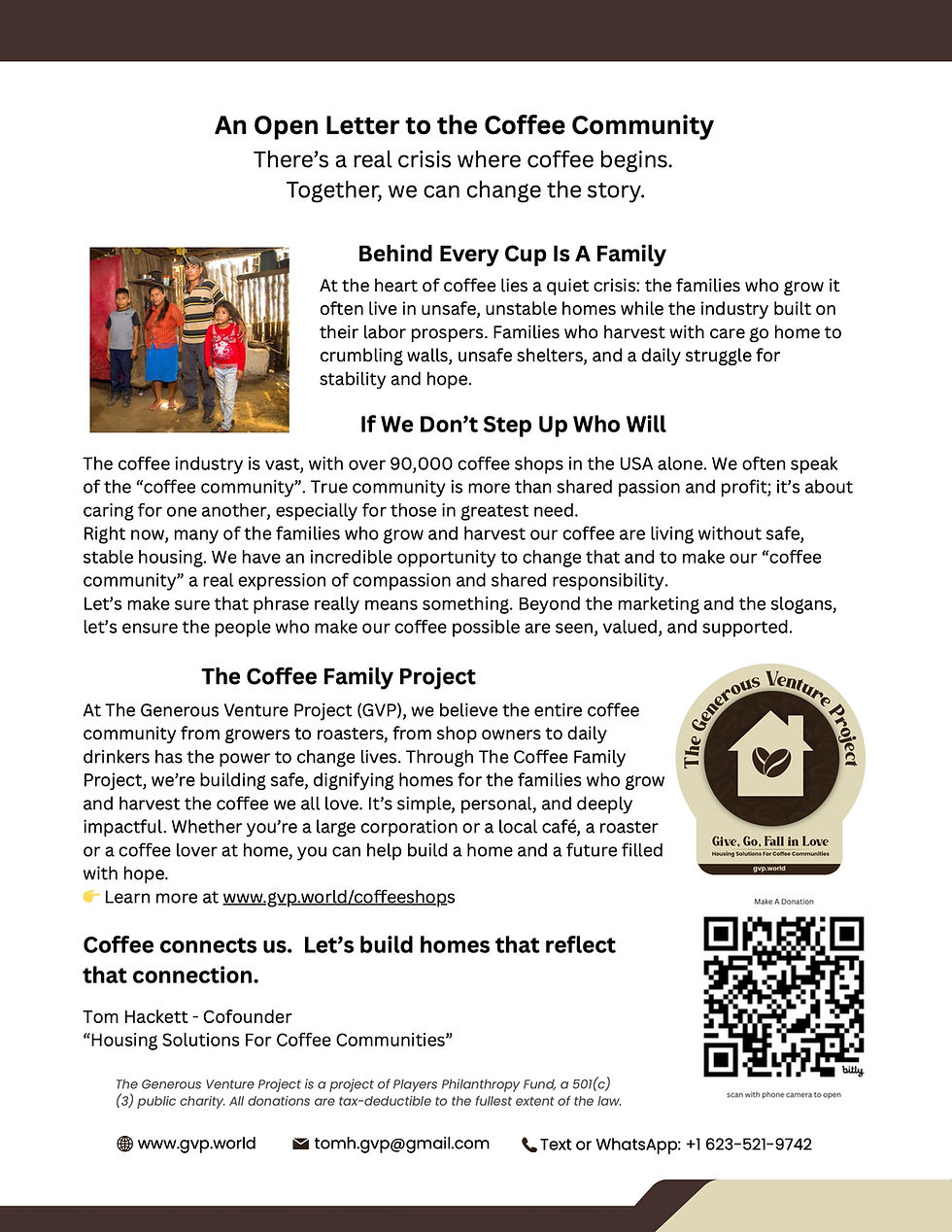
The Big Problem: The invisible poverty behind your morning coffee.
The Calling: Why I started A Youth With A Mission Operating Location in Mazatlan, Mexico, The mission organization Alternative Missions, A church planting base in Nayarit, Mexico, A medical/dental clinic and school in Roatan, Honduras, DwellingsNow - A home building mission in Honduras, Mexico, Cuba, and Colombia, and The Generous Venture Project with a focus on coffee farm worker families where faith and risk intersect.
The Model: A simple idea that works - farm owners as build coordinators, Coffee Shops and other coffee related businesses as Networking Partners, donors as adventurers.
The Miracle of Scale: How a small act of generosity can ripple across nations.
The Ask: Invite coffee people to become part of the story.
“More Than a Home”
By Thomas Hackett – Co-Founder, The Generous Venture Project
“I want to show you something that changed the way I think about charity... forever.”
(Pause)
It’s a pyramid. Simple shapes. Five colored layers.
But this image? This pyramid holds the secret to why a concrete house - four walls and a roof can change everything for a family living in poverty.

1. PHYSIOLOGICAL NEEDS
(Base layer – blue)
Let’s start at the bottom. Maslow called this “physiological needs” - air, water, food, shelter. The basics of survival.
Now picture this: A mother in rural Honduras, raising three kids in a home made of sticks, plastic sheets, and mud. When it rains, water floods the floor. When the wind blows, she wraps her babies in blankets and prays the roof doesn’t lift off.
She’s not dreaming of Harvard or healthcare.
She’s dreaming of dry ground.
This is where we start. Because you can’t dream when you’re drowning.
2. SAFETY NEEDS
(Second layer – purple)
Once the rain stops falling inside the house…Once a family has a door that locks,a roof that holds, a floor that doesn’t turn to mud…
Then something amazing happens: they start to breathe differently.
There’s peace at night. Children stop getting sick. Parents go to work without fear.
This is the moment safety begins, a moment we often take for granted.
3. SOCIAL BELONGING
(Third layer – red)
Now here’s where the magic kicks in…
You see, a home isn’t just a building. It’s an invitation. A place where neighbors stop by. A place where a child can say, “Come over to my house.”
One little boy we built for wouldn’t let us leave without walking us through each room. The joy in his face when he said, “Este es mi cuarto!” “This is my room.”
He had never said those words before. Now he belonged somewhere.
4. ESTEEM
(Fourth layer – pink)
Here’s the truth about poverty:
It doesn’t just steal food and shelter. It steals your dignity.
But when a dad helps lay the bricks for his own family’s house…When he sees the roof go on…When he turns the key for the first time…
You can see it in his eyes: he feels like a provider again.
That’s not just about shelter, it’s about identity. It’s about hope returning.
5. SELF-ACTUALIZATION
(Top layer – yellow)
And finally at the top comes the most surprising part.
The desire to become the most that one can be.
When you don’t have to worry about surviving…You can finally start imagining what you’re meant to do.
We’ve seen women start micro-businesses from their new homes. Children go back to school. Families get involved in community leadership.
All because someone gave them the foundation to stand on.
Closing Slide: “More than a Home” – Reappear the Pyramid
“So yes, we build homes. But really… we’re building launchpads.”
“Because at The Generous Venture Project, we believe every person deserves the chance to rise not just survive.”
“It starts with shelter. But it never ends there.”
(Pause)
Join us. Let’s build more than homes. Let’s build futures.
Supporting Research and Material
Executive Summary
The Generous Venture Project (GVP) is a U.S. based nonprofit initiative with a mission to build safe, dignified homes for coffee farm workers and their families. Our scalable model engages local farm owners as volunteer home coordinators, partners with donors from the coffee industry and beyond, and delivers complete homes using local materials, skilled labor, and community input.
The GVP is seeking funding to expand its work across coffee-producing regions by building homes in partnership with coffee farms, community leaders, and mission-minded donors. This project addresses generational poverty and housing insecurity in a way that is community-empowered, cost-efficient, scalable, and culturally appropriate.
Organizational Background
The Generous Venture Project was Co-founded by Tom Hackett and Henry & Cheryl Ong as a project of Players Philanthropy Fund, Inc., a Texas nonprofit corporation recognized by IRS as a tax-exempt public charity under Section 501(c)(3) of the Internal Revenue Code (Federal Tax ID: 27-6601178,ppf.org/pp). Contributions to The Generous Venture Project (GVP) qualify as tax-deductible to the fullest extent of the law.3.
Statement of Need
The coffee industry supports millions of farmers worldwide, yet many of its workers live in poverty, without access to safe or permanent housing. In Honduras, a leading coffee exporter, it’s common for workers to live in makeshift homes made of wood scraps, tarps, or sheet metal vulnerable to weather, disease, and displacement.
Lack of housing contributes to:
Family instability
Migration to urban slums or abroad
Health and sanitation risks
Interrupted education and childhood development
While large coffee companies benefit from global markets, those who harvest the beans often live in desperate conditions. GVP seeks to close that gap with a direct, high-impact solution: build homes, strengthen families, and stabilize communities.
Project Description
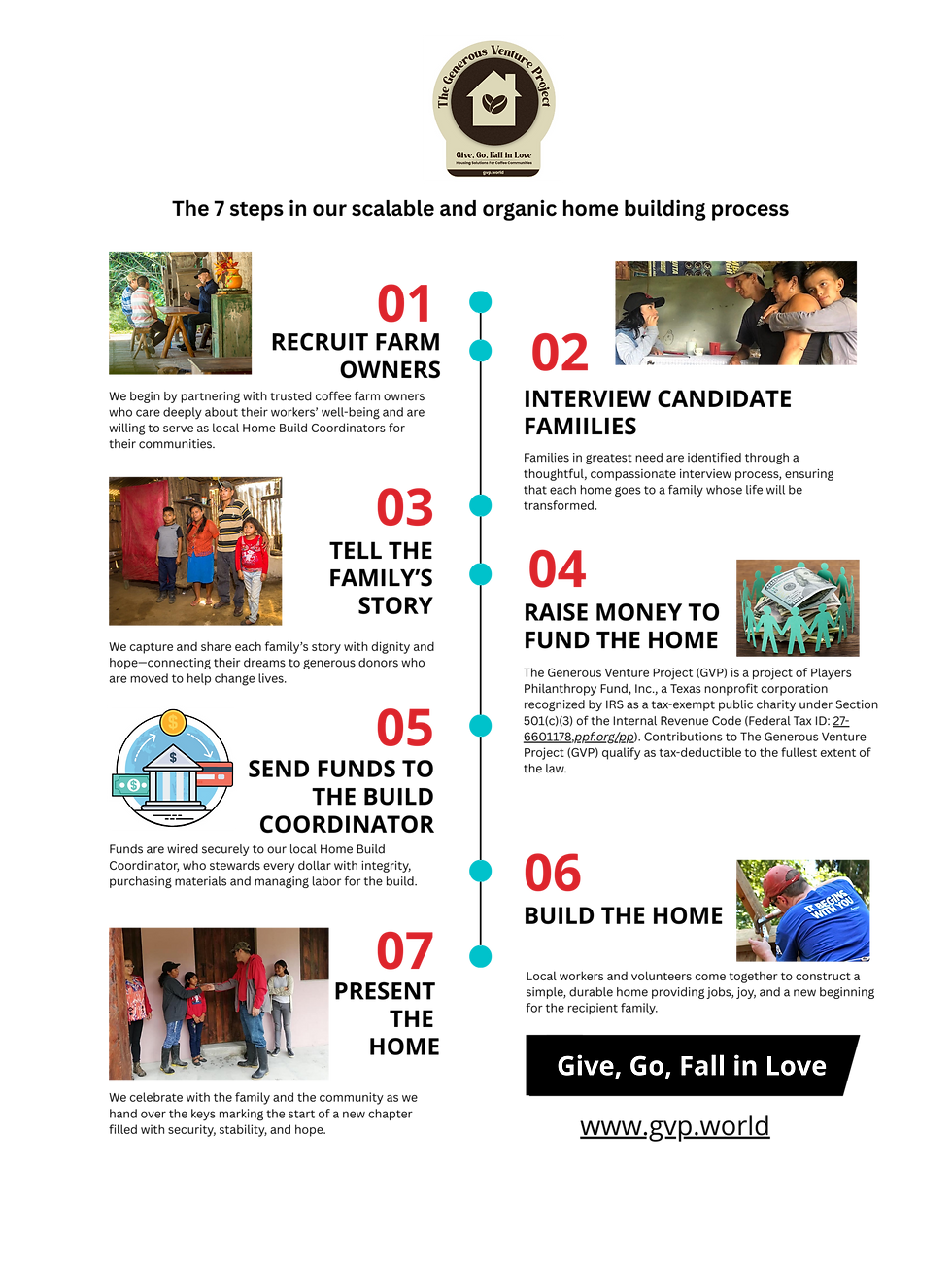
The GVP Homebuilding Model
Local Identification of Need: Farm owners and community leaders identify families most in need of secure housing.
Volunteer Coordination: Farm owners volunteer as Home Build Coordinators to oversee the local logistics, construction, and follow-up.
Donor Engagement: U.S. donors including individuals, coffee shops, roasters, and corporations provide the funding per home.
Local Implementation: Homes are constructed using locally sourced materials and local labor, strengthening the regional economy.
Monitoring & Evaluation: The GVP tracks each build, collects photos, GPS data, and family stories to ensure transparency and impact.
Home Features
2 Bedrooms, 1 Bathroom
Kitchen, Dining, and Living Room
Water Catchment System and Septic System
Concrete block design for permanence
Connection to Public Electric Power or Solar-ready for off-grid
Expandable layout for future improvements
Outcomes and Impact (example only)
In 2024–2025, The GVP will focus on:
Building 3+ homes in coffee communities in Honduras
Establishing partnerships with 10+ coffee farms and cooperatives
Creating a replicable strategy to expand into other coffee-producing regions (e.g., Colombia, Guatemala)
Expected Impacts:
Families move from makeshift to permanent homes
Increased stability, health, and safety for children
Stronger community trust between farms and workers
Greater donor engagement from the global coffee sector
Each home provides a transformational, generational impact that lifts a family out of crisis into security.
6. Scalability and Sustainability
The GVP is uniquely scalable due to its:
Decentralized Implementation: Local farm owners manage builds, reducing admin personnel and overhead
Replicable Model: The same strategy can be applied to farms across regions with minimal adaptation
Efficient Cost Structure: Each home averages $16,000 USD (with adjustments based on size and design of the home, inflation, location - Our first Colombia home included the cost of 70 mule trips to get the materials to the site!
Funding Flexibility: Homes can be funded through donations by individuals, groups, companies, churches and grants.
As funding increases, The GVP can scale from dozens to hundreds of homes per year. The model remains faithful to its grassroots origins while expanding its reach through partnerships and storytelling.

Appendices
Sample house plan drawing
Photos of completed homes
Testimonials from farm owners and families
Letters of support
Advisory board bios
Fiscal sponsor documentation
9. Strategic Framework: “More Than a Home”
The Generous Venture Project embraces a holistic view of human development, inspired by Maslow’s Hierarchy of Needs. Our work begins by meeting basic physiological needs — providing shelter — but the impact doesn’t stop there.
With a safe, dignified home:
Families gain security (safety needs)
Children experience belonging and stability (social needs)
Parents build self-worth and dignity (esteem)
Communities foster hope and purpose (self-actualization)
🌾 1. Widespread Rural Poverty & Housing Crisis in Honduras
Over 60% of Honduras’s population live below the poverty line, with 53% in extreme poverty foodforthepoor.org+15en.wikipedia.org+15habitatforhumanity.org.uk+15.
A staggering 63% of the rural population lives in poverty, and 50% of rural households endure extreme poverty american.edu.
Approximately 63% of Hondurans live in poverty, with even higher concentration of poverty in rural areas, compared to the national average rikolto.org+15wfp.org+15foodforthepoor.org+15.
🏚️ 2. Severe Housing Deficit & Poor Living Conditions
63% of households lack adequate housing: 1.36 million homes are considered substandard nationaltpsalliance.org+1artforhumanity.org+1.
An estimated 1.1 million homes have a housing deficit—400,000+ families need completely new housing borgenproject.org+15habitatforhumanity.org.uk+15wfp.org+15.
50% of rural homes lack electricity, and 13% have no access to water or sanitation wfp.org+2habitatforhumanity.org.uk+2en.wikipedia.org+2.
☕ 3. Coffee Farm Workers in Poverty & Inadequate Housing
Most coffee producers in Honduras live below the poverty line of $1.53/day, compared to a $2.72/day desired benchmark borgenproject.org+15rikolto.org+15researchgate.net+15.
Only 33% of coffee farmworker families own their homes, and rental options are scarce—many live in informal or precarious dwellings on the farms perfectdailygrind.com+1borgenproject.org+1.
🏞️ 4. Broader Latin America Rural Housing Challenges
Across Latin America, roughly 70% of those in extreme poverty live in rural areas, which suffer from high housing needs and lack of infrastructure worldbank.org+9en.wikipedia.org+9en.wikipedia.org+9.
In Honduras alone, the rural housing shortage is 1.1 million homes of need, with 750,000 requiring improvement habitatforhumanity.org.uk.
🔍 Why These Numbers Matter to The Generous Venture Project
Challenge | Impact |
Massive unmet housing demand | Millions of rural Hondurans lack basic shelter |
Income gap for coffee workers | They cannot earn enough to build homes |
Extreme poverty linked to housing deficit | Shelter insecurity compounds health, migration, educational risks |
Infrastructure gaps | Electricity, sanitation, or clean water |
These statistics reveal that The GVP’s mission—building safe, permanent homes for coffee farm workers—is not just timely, it’s essential. Our support directly addresses systemic need: ending shelter insecurity and lifting families out of extreme poverty.
🌱 Who Makes Up the Coffee Workforce?
1. Smallholder & Family‑Based Labor
About 85% of coffee in Honduras is produced by small and medium-sized farms, employing a mix of family and hired labor theguardian.com+15technoserve.org+15dol.gov+15apps.fas.usda.gov+2en.wikipedia.org+2apps.fas.usda.gov+2.
Roughly 120,000 coffee-producing families operate these farms, with harvest seasons requiring up to 300,000 additional rural workers technoserve.org+1dol.gov+1.
Child labor often occurs within these family systems, with parents and children working side by side in fields theguardian.com+1gcrmag.com+1.
2. Seasonal and Temporary Workers
During peak harvest times, an estimated 350,000 coffee pickers are needed in Honduras, including ~50,000 migrant laborers from neighboring countries gcrmag.com+15apps.fas.usda.gov+15apps.fas.usda.gov+15.
This indicates heavy dependence on temporary migrant labor, underscoring economic instability within rural communities.
3. Ethnic Makeup: Mestizo and Indigenous
The Mestizo population (mixed Indigenous and European descent) represents about 83–87% of Hondurans, and largely comprises coffee workers gcrmag.com+4en.wikipedia.org+4en.wikipedia.org+4en.wikipedia.org+6en.wikipedia.org+6en.wikipedia.org+6.
Among coffee farms in regions like Marcala, ~34% identify as Indigenous Lenca, with Mestizo families making up most of the remainder en.wikipedia.org.
4. Gender and Poverty Dynamics
Women often play essential roles in planting, harvesting, and processing. Many head-of-household women live on subsistence-level incomes due to wage inequality.
Nearly all coffee workers fall below the household living wage (~$450/month), with actual wages around $283–$343/month (legal minimum) .
🤔 Why This Matters
Coffee workers are economically vulnerable—relying on daily wages from seasonal farm jobs. They cannot afford to build adequate homes.
Family farms lack access to credit or infrastructure, making permanent shelter unrealistic without external support.
Living in inadequate housing subjects them to health risks, unstable environments, and intergenerational poverty, perpetuating the cycle of vulnerability.
📌 Key Takeaways for The GVP's Mission
Our focus on working with smallholder, family-based farms aligns perfectly with the demographic core of the coffee labor force.
By empowering mestizo and Indigenous families—who are the backbone of rural coffee economies our programs foster equity and inclusive development.
The GVP’s model targets the people most in need, delivering stable, permanent housing as a critical step toward long-term resilience and dignity.


Comments